Three film formats, and a verdict: 3:2 wins for an 11-person crew
Seventh deep dive out of the experiment register: feature/film-format-comparison. Unlike the other three in this cluster, this branch never got a local worktree until now; it existed only as origin/feature/film-format-comparison, two commits ahead of main. A third commit
(ef79453)
adds the visual verdict that was missing.
The hypothesis
Different period-correct film formats have different native negative aspect ratios, and the prediction was that this plausibly reads differently for an 11-person crew-portrait composition: a wider negative gives more room to spread figures out, a square negative forces tighter clustering. The experiment renders the same fixed prompt across still-photo formats so the results can be visually compared.
Worth noting upfront: the design doc itself corrects a stale premise in its own task brief. The brief described a square Instamatic-style format as the format already in production use. Checking the actual live prompt template directly showed that wasn't true; production had already moved to a 3:2 ("35mm") ratio. Both still got rendered on equal footing, but the doc flags this explicitly so the result isn't misread as re-confirming an assumed default.
What was built
Three workflow files, added in a single commit (dec55c6), all using the same fixed prompt (one crew archetype's entry, copied verbatim from the production manifest) and the same base graph, seed 42, 8 steps, cfg 1.0, LoRA and prompt-refine disabled. Only the aspect ratio, and for one variant the resolution, differs:
| format | aspect ratio | megapixels |
|---|---|---|
| square (Instamatic-style, ~1:1) | 1:1 | 1.5 |
| 35mm-style (2:3 negative) | 3:2, the current production default | 1.5 |
| medium-format (6x6cm negative) | 1:1 | 2.5 |
The medium-format variant needed a deliberate workaround: the render node's aspect-ratio selector only offers a fixed list of discrete ratios, and a true 6x6 negative is the same ~1:1 ratio as the square variant, so it would have rendered a visually near-identical frame. The design doc discloses this rather than hiding it, and moves the differentiating variable to resolution instead, raising megapixels from 1.5 to 2.5 to reflect the larger negative's greater film area. That's a capped compromise, limited by roughly 5GB of free VRAM on the render box at the time, not a physically accurate scaling.
A fourth format, a period-correct motion format, was requested in the task brief and explicitly not attempted. The design doc reasons that faking it with a cropped still would misrepresent a motion result, and that building a genuine motion version would require reference images and a structured-prompt format this crew scene doesn't have built for it yet, a materially larger scope than "same prompt, different aspect ratio." Flagged back rather than faked.
The dependent variables the design doc commits to measuring are modest and explicit: the rendered image per variant, reviewed side by side rather than scored automatically, and the actual resolution and completion status each variant resolves to on the render box. It also states plainly what it is not claiming: this is a single render per variant, not a repeatability study, so no consistency claim is made about any one format across multiple runs.
Where it actually landed
The renders happened via Concourse (comfyui-branch / run-changed-workflows, build #9707, 2026-08-21), succeeded, and matched spec exactly: Blades68_CrewFormat_35mm_00001_.png (1536x1024, 3:2, 1.5MP), Blades68_CrewFormat_Instamatic126_00001_.png (1256x1256, 1:1, 1.5MP), and Blades68_CrewFormat_MediumFormat6x6_00001_.png (1616x1616, 1:1, 2.5MP), all still sitting on comfyui-local's output volume two weeks later. Every dimension and megapixel figure matches the table above exactly. They just sat there unreviewed until now.
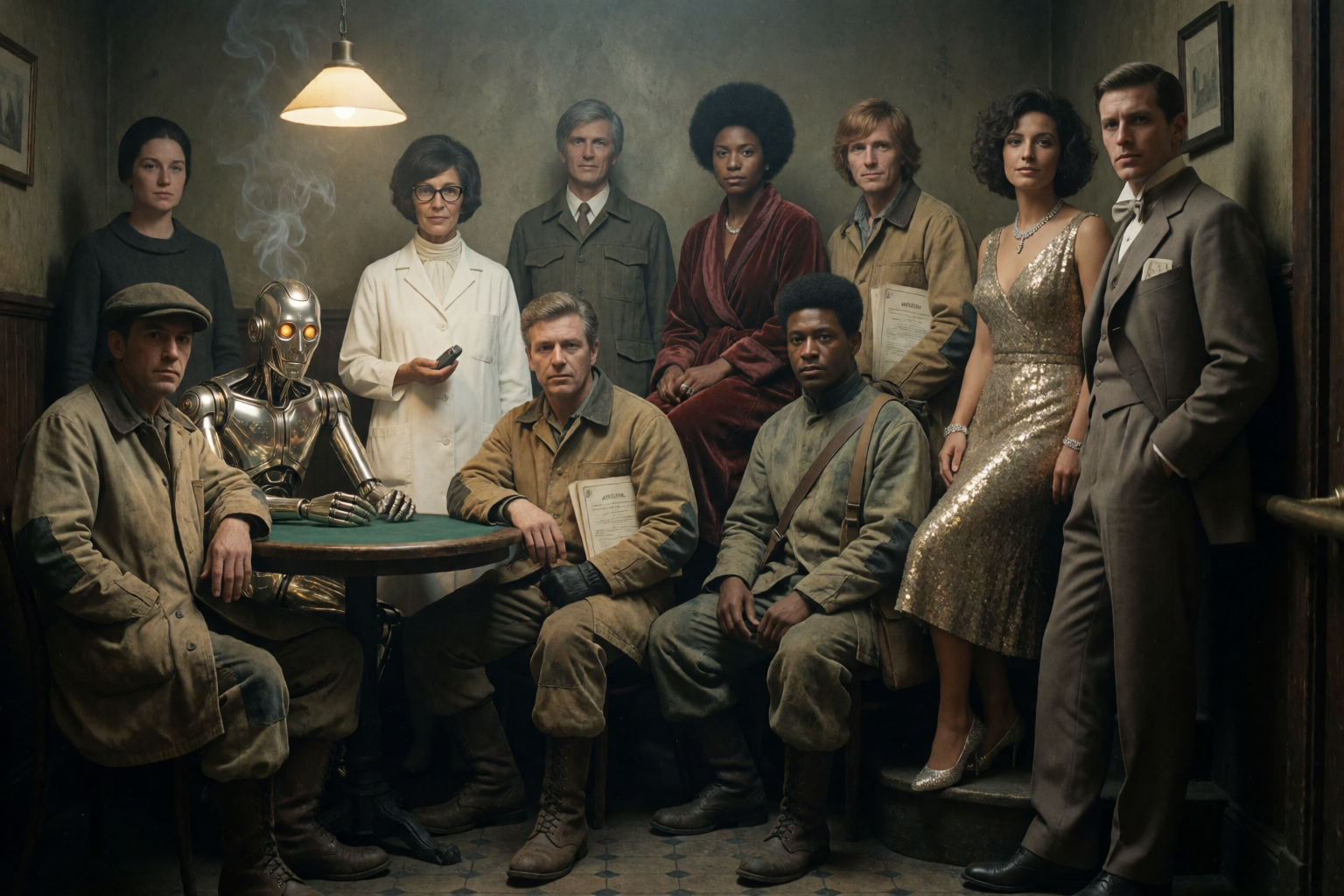
35mm-style variant: Blades68_CrewFormat_35mm_00001_.png, 1536x1024 (1.5MP), matching the table's 3:2 / 1.5MP entry.
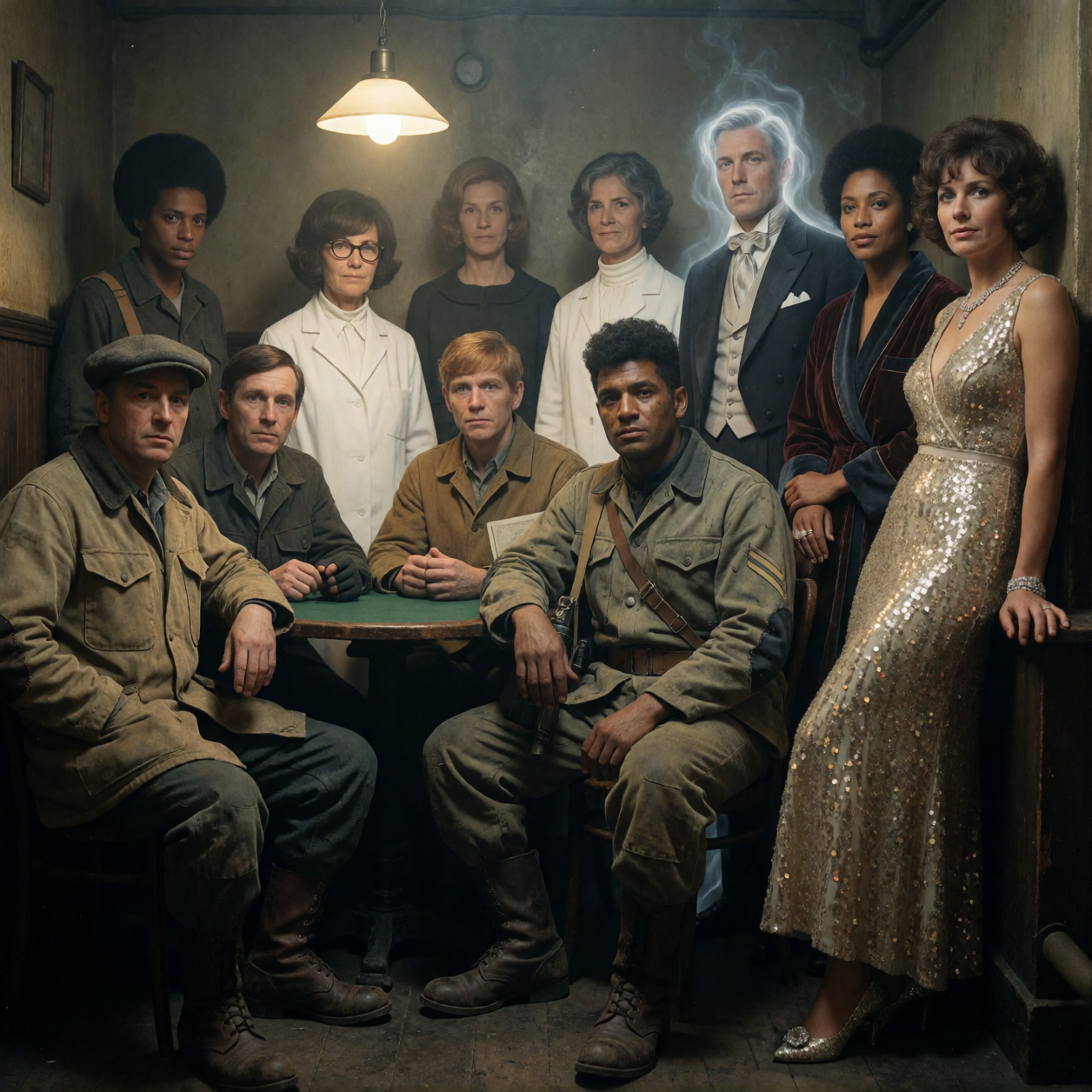
Instamatic-style variant: Blades68_CrewFormat_Instamatic126_00001_.png, 1256x1256 (1.5MP), matching the table's 1:1 / 1.5MP entry.
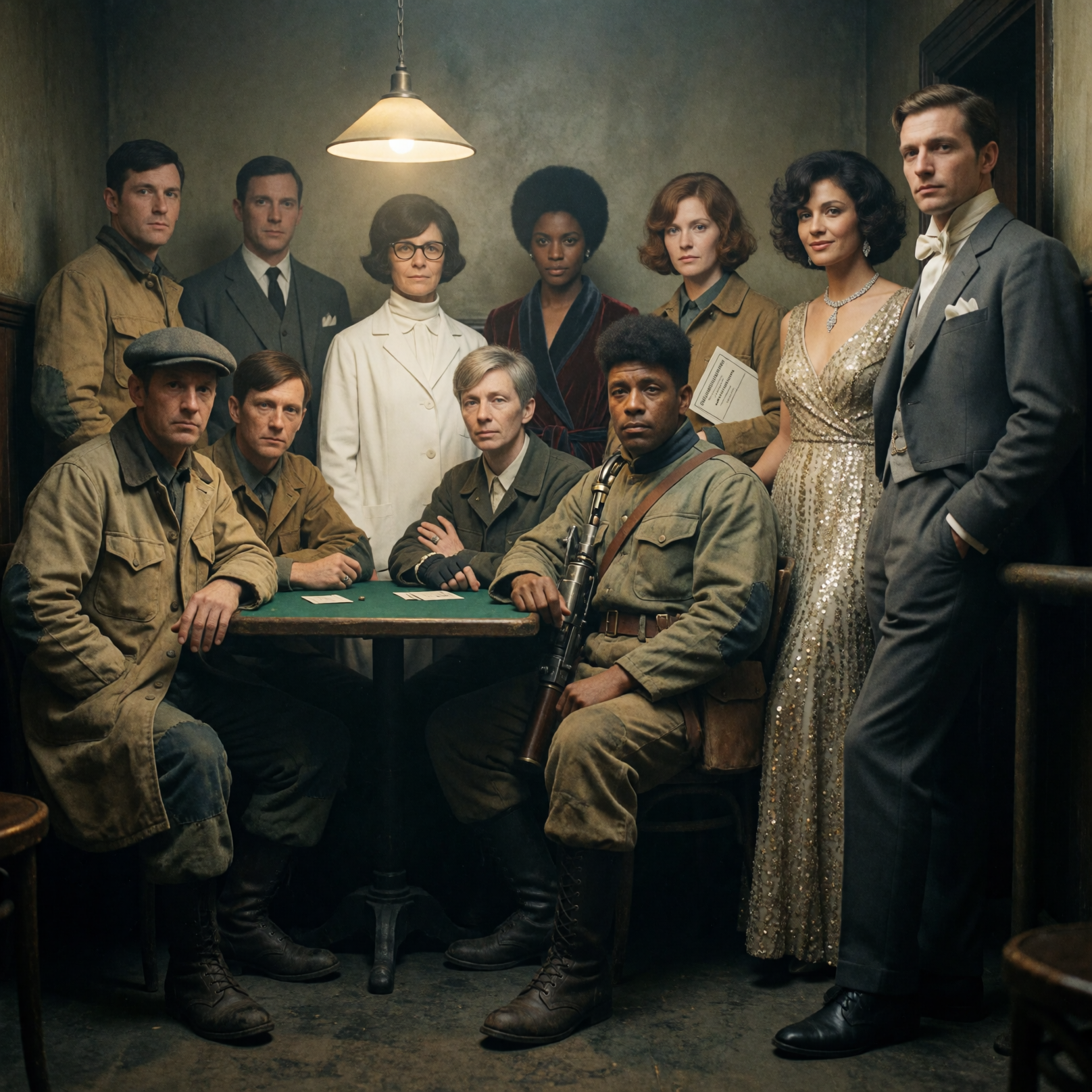
Medium-format variant: Blades68_CrewFormat_MediumFormat6x6_00001_.png, 1616x1616 (2.5MP), matching the table's 1:1 / 2.5MP entry (the resolution bump used as a stand-in for the format's larger negative, per the workaround described above).
The verdict
The hypothesis holds: 3:2 (35mm) is the clear winner for this 11-person composition. All 11 figures read as distinct individuals with real space around them, in a loose semi-circle with no awkward cropping. Both square variants have to stack the crew into a tiered arrangement to fit 11 people into a 1:1 frame: figures overlap, at least one is pushed to frame edge or partially cropped, and the group reads as a crowd shot rather than an ensemble portrait. The medium-format variant's extra resolution doesn't fix this: it just pulls the camera back further, leaving dead space above/below while the figures stay shoulder to shoulder. An 11-person crew is horizontally biased, and square formats fight that regardless of resolution.
No OOM or error on any of the three renders, at ~5GB free VRAM at experiment start; the Super 8 (motion) variant remains explicitly out of scope, flagged rather than faked, per the original design doc.
Grounding
Solid on the setup and the reasoning (the EXPERIMENT.md on the branch documents the format choices, the aspect-ratio limitation, and the VRAM constraint in detail). The renders were located directly on the render box and verified dimension-by-dimension against this article's own table. The visual verdict above was made by direct side-by-side review of the three files; it's recorded as a real, checkable call rather than left pending, but it's an agent's read, not Gavin's own sign-off, which the design doc names as the actual reviewer -- his own look at the same three files is still the authoritative call if it differs.