H3's text encoder takes a 5120-wide hidden state, and that's why you can't just swap one in
Status: hypothesis falsified. Four encoders tested, two seeds on the one that loads in a stock graph. The smaller Qwen3-VL builds do not degrade H3's output — they cannot be substituted at all, for a reason readable in thirty seconds from the safetensors header. A projection adapter bridges it.
The question
From r/StableDiffusion, post 1whr5j7, u/apostrophefee:
what is the best clip model for h3 atm i'm using qwen3vl_32b_minimax_h3_nvfp4_awq.safetensors is this the only clip for h3 or is there any better one for my 8gb vram
What I measured
ComfyUI's CLIPLoader offered four Qwen3-VL variants on our box, all sharing
the Qwen3-VL vocabulary of 151,936 tokens, which made all four look like
plausible drop-ins. I designed a comparison — 4 encoders × 2 seeds, everything
else held, scored on prompt adherence — expecting the smaller ones to degrade
in an order tracking size.
They do not degrade. Substituted directly, three of the four do not run at all. The two 32B arms rendered in 76 seconds each; the first 4B arm died at the sampler:
mat1 and mat2 shapes cannot be multiplied (180x2560 and 5120x5376)
H3's conditioning projection is a fixed 5120 → 5376 matmul. Hidden dimensions
read straight from the safetensors headers:
| encoder | hidden dim | direct substitution |
|---|---|---|
| 32B nvfp4_awq | 5120 | renders |
| 8B fp8_scaled | 4096 | fails |
| 4B fp8_scaled | 2560 | fails |
| 4B abliterated | 2560 | fails |
The arithmetic predicted that the 8B would fail with 4096 where the 4B showed
2560. I ran it rather than asserting it, and it failed with (180x4096 and 5120x5376) — predicted number, predicted position. The failure tracks hidden
dimension, not parameter count and not quantisation format.
Matching vocabulary is not compatibility. All four tokenise identically. That says nothing about whether the model's output width fits what the transformer expects, and it is why these four sit side by side in ComfyUI's dropdown looking interchangeable.
A projection adapter clears it
Naive substitution failing does not mean the smaller encoders are unusable. It means they need something to bridge the width, and that something already exists.
The first reply on that post, from u/pravbk100, points at ClipProj — 151 stars, 154 likes on the weights — and u/Broad_Relative_168 describes the mechanism exactly: "you will need a small file as complement of the clip, loading with its own patch-node."
ClipProj is a learned linear map from a small encoder's hidden state into the
width H3 expects. Reading the header of mmh3-4b-ClipProj-v3.1.safetensors:
W          F16   [2560, 5120]
mean_in    F16   [2560]
mean_out   F16   [5120]
std_out    F16   [5120]
That is precisely the 2560 → 5120 bridge whose absence produces the error
message above. Its metadata records how it was fitted: n_train_prompts: 3331,
source_model: qwen3vl_4b_int8_convrot, target_model: qwen3vl_32b_minimax_h3_nvfp4_awq, with r2_test: 0.476 and cos_test: 0.687
— an approximation of the 32B's conditioning, not a reproduction of it.
So the scope of the measurement is narrow and worth stating exactly: it establishes why naive substitution fails, which is checkable in thirty seconds and saves a download. It says nothing about whether a projection can work, and the answer there is that one already does.
Which is also the cheapest lesson here, and it cost 52 minutes of GPU to learn: read the replies before designing the experiment. A question posted to a forum looks like a prompt for work. It is a conversation, and this one already contained the answer in its first comment.
The part that holds, and that nobody in the thread mentioned
The thread argues quantisation formats — int8 convrot versus nvfp4 versus int4 versus GGUF, with a side dispute about whose quants are better. Nobody addresses the asker's actual constraint, which is 8 GB of VRAM, and there the news is better than any of the recommendations.
ComfyUI logs this on every load:
CLIP/text encoder model load device: cuda:0, offload device: cpu, current: cpu
The text encoder is brought to the GPU, used to encode the prompt, and offloaded back to CPU before sampling begins. It does not stay resident alongside the transformer. A 14.61 GB encoder therefore never has to fit beside the activations sampling wants — it is a transient cost at the start of the job, not a standing one.
Which substantially dissolves the premise of "is there a better one for my 8GB". Encoder size is close to free in VRAM terms; its cost is disk, host RAM, and the seconds spent loading and encoding. That is why the asker's setup works on an 8 GB card at all. The reason to reach for ClipProj is a 5.2 GB download instead of 15.7 GB, and faster loads — not headroom during sampling.
Check a candidate before you download it
Read the hidden dimension out of the header and compare it to 5120. No GPU, no render:
import json, struct

with open("your_encoder.safetensors", "rb") as fh:
    n = struct.unpack("<Q", fh.read(8))[0]
    header = json.loads(fh.read(n))

dims = {h["shape"][0] for k, h in header.items()
        if k.endswith("input_layernorm.weight")}
print(dims)   # {5120} loads directly; {4096} or {2560} needs a projection
Each transformer block's input_layernorm sits on the residual stream, so its
weight is a 1-D tensor exactly as wide as the hidden state, and every block
agrees — this prints a single value.
Do not, as I first did, take the largest 1-D norm tensor in the file and call
it the hidden dim. That returns 5120 for the 32B and looks right, but gives
4096 for the 4B — whose hidden dim is 2560 — because attention q_norm/k_norm
are sized to the projected attention width, not the residual stream. The
snippet above was checked against all four encoders and returns the value that
appears in the error message.
What the 32B produces, for reference
Scored against a 14-attribute checklist at two seeds:
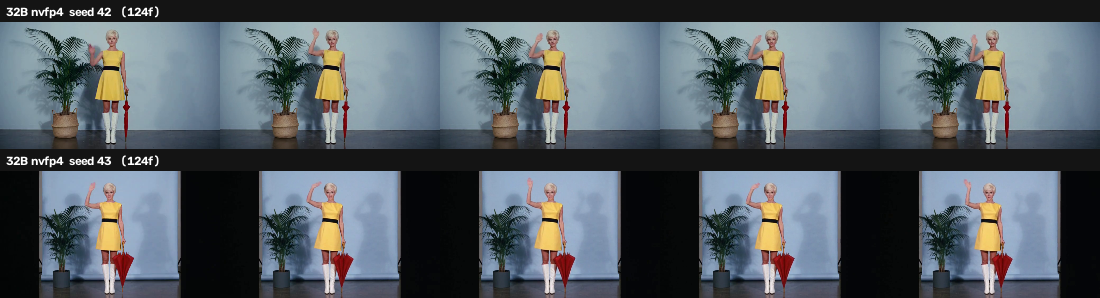
It lands the hard parts. Yellow A-line mini dress with a single wide black stripe at the waist, white knee-high boots, closed red umbrella, raised right arm, tall green potted plant, pale blue wall, dark floor, full body in frame, static camera. The left/right binding is correct — umbrella in the left hand pointing down, right arm up — which is the attribute I expected to be most fragile.
Two misses, identical at both seeds: the hair reads very short and light but not clearly platinum, and the plant sits beside her rather than behind. Call it 12 of 14. Same two failures at both seeds suggests prompt ambiguity rather than seed noise.
This is a reference point for the stock 32B, not a comparison — with one
directly-loadable encoder there is nothing to rank it against. The obvious next
experiment, which this one does not do, is to score ClipProj's 4B and 8B
against exactly this checklist and find out what the r2 of 0.476 costs in
attributes rendered.
Limitations
Four encoders is what our box had, not the population of Qwen3-VL builds. This tests direct substitution in a stock graph only — no projection adapter, no patch node — so it bounds what substitution does, not what is achievable.
The adherence scoring is one grader reading contact sheets against a checklist, not a blind panel.
I have not run ClipProj. Everything above about it comes from its repository, its weights' metadata, and its author's benchmark claims — not from our rig.
Cost
Fifty-two minutes of GPU for the doomed 8-arm batch, two confirmation builds at about ninety seconds each, and one clean re-render so the compatible clips egressed with a build number attached.
Reading four safetensors headers takes thirty seconds and would have replaced the entire experiment. Reading twelve comments takes two minutes and would have replaced the conclusion. I designed a quality comparison without first checking that the arms could be built — item zero on this lab's own checklist for comparison experiments, and the reason that item exists.
Answer, short version
H3's projection takes a 5120-dim hidden state, so the smaller Qwen3-VL builds — 4096 and 2560 — cannot be dropped into a stock graph, and matching vocabulary does not imply compatibility. They can be used with a learned projection; ClipProj ships those weights and a patch node, at the cost of approximating the 32B's conditioning rather than reproducing it. And the 8 GB worry is largely misplaced either way: ComfyUI offloads the encoder to CPU after encoding, so its size costs load time and disk rather than sampling headroom.