A reference video keeps a character across seeds
Status: complete. Eight arms, four seeds, one prompt: supplying a prior render as a reference video cuts seed-to-seed variation by 82%, and the character it holds is the one in the reference.
The question
MiniMax H3 gives you a different person every time you change the seed. Same prompt, same everything else — a new face, a new dress. For a single clip that does not matter. For a sequence of shots meant to show the same character, it is the whole problem.
H3's MiniMaxH3ReferenceToVideo node takes an optional ref_videos input,
described as reference frames at 24 fps. Whether it can pin a character across
seeds is the question here.
A prior experiment on this node supplies the motive. Feeding it a foreign guide video — a Wan2.1 VACE render of a different subject — left seed-to-seed distance at 7.16 where a pose skeleton gave 11.38. The reference halved the output's sensitivity to the seed while transferring none of the guide's content. A number like that is either a consistency lever or an artefact of a subject that had gone inert, and the two look identical from one measurement.
Method
Eight arms. One prompt, held identical and asserted in the builder. Four seeds — 43, 44, 45, 46 — crossed with reference present or absent.
The reference is a prior H3 render of this prompt's own subject: an earlier seed-43 clip, first 90 frames, scaled to the shot. That is the production workflow — render a character once, then keep her across later shots — so the reference is what someone would really feed it, rather than footage of a stranger.
FunControl is absent from both arms, enforced by assertion rather than inspection. H3 has two video inputs, and leaving a control video attached would make any effect unattributable between them.
Shot is 832×480, 124 frames, which satisfies H3's 17n + 5 frame constraint.
The reference is 90 frames, inside the node's stated 2–15 s window and also
17n + 5. The smaller shot buys four seeds per arm rather than two, so seed
variation comes from six pairwise distances per arm instead of one.
Two measures, because one cannot answer the question.
Seed variation is the mean pairwise pixel distance across the four seeds within an arm. Within-clip motion is the mean absolute frame-to-frame difference. A reference can lower seed variation two ways: by pinning identity while the subject still acts, or by collapsing every seed toward the same inert portrait. Both produce a low number; the first is a capability and the second is a defect wearing its clothes. Motion separates them.
The null is the no-reference arm, measured in the same units, at the same resolution, on the same four seeds. Its seed variation is what the metric reads when nothing is pinning the output — 33.02, established here rather than borrowed from another run.
The decision rule, fixed before rendering. Reference cuts seed variation by at least 25% and holds motion within 25% of the null: stabilising. Cuts both by more than 25%: flattening, and worthless. Seed variation within 25% of the null: no effect. Anything else, including a reference that increases variation: indeterminate, reported as such.
One failure mode is registered in advance because it is the one most easily rationalised away: if the reference arms simply reproduce the reference clip's composition, that is flattening by another name, and distance from each arm to the reference clip itself tests it.
Results
| no reference | with reference | change | |
|---|---|---|---|
| seed variation | 33.02 | 6.01 | −81.8% |
| within-clip motion | 0.50 | 2.32 | +364% |
| distance to the reference clip | 26.53 | 8.91 | −66% |
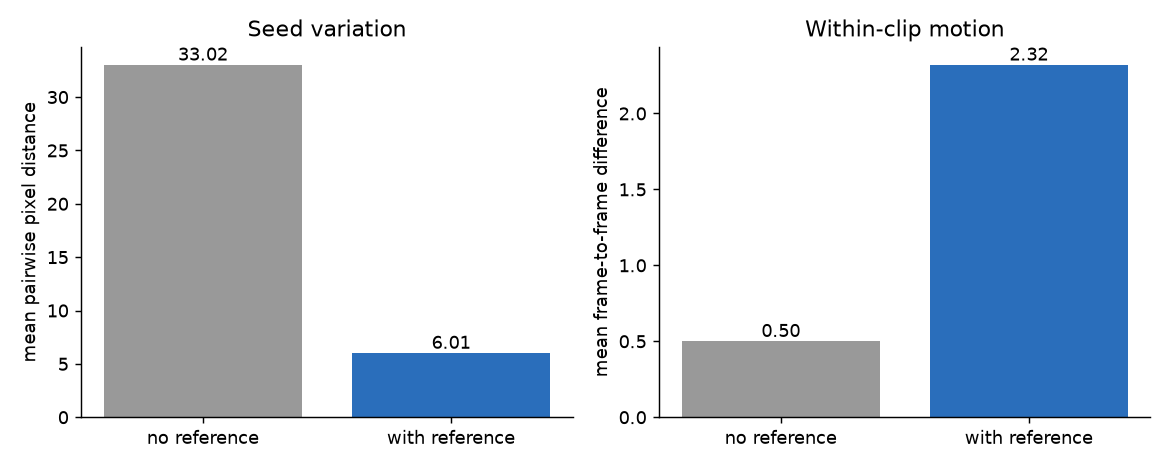
Seed variation falls by 81.8%. Motion does not fall with it — it rises. By the registered rule this is stabilising, and the direction of the motion change rules out flattening outright rather than on a threshold.
Per-arm figures show the same thing without averaging. Pairwise seed distances run 21.41–42.68 without a reference and 3.81–7.27 with one: every reference pair is tighter than every no-reference pair. Motion runs 0.34–0.66 without and 1.45–3.79 with.
The registered failure mode does not hold. Arms given the reference sit at 8.91 from it against the null's 26.53 — closer, but not a copy, and their motion (2.32) stays well below the reference clip's own (4.91). A replay would match it and would not vary across seeds the way these do.
What it means
The reference holds the character, and holds the right character.

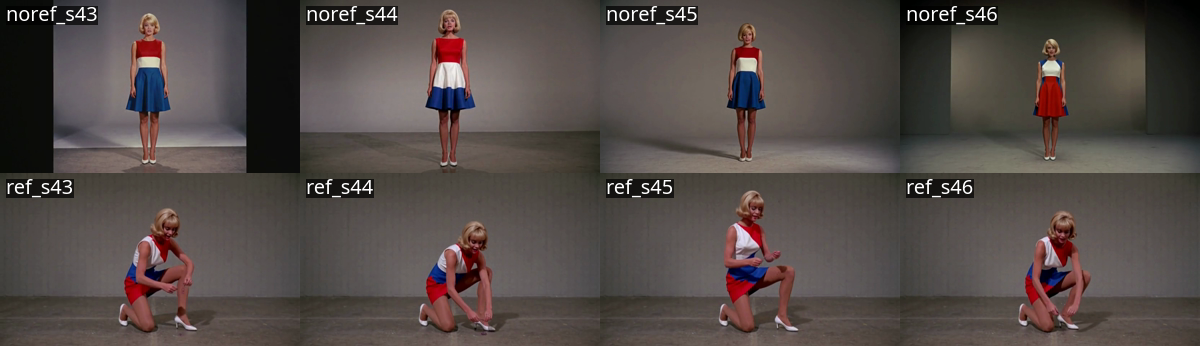
The garment settles it. The reference clip wears a straight-cut dress with a red hem. The arm given that reference wears the same straight cut and the same red hem; the same seed without a reference wears a pleated dress with a blue hem. Lower-garment red-minus-blue is +23.9 to +30.4 across the reference arms, tightly clustered, against +14.2 to +19.4 spread wider across the null.
This distinction matters more than the headline number. Four arms agreeing with each other would be consistency without fidelity — useful for a fresh sequence, useless for continuing a character who already exists. These agree with the source.
So the recipe is: render a character once, keep the clip, feed it forward as
ref_videos on every later shot. Cost is 1.33× the render time, measured on
the same node.
Pixel distance is the wrong instrument for the last step, and it is worth saying why the garment reading is done by eye. Mean pixel distance cannot represent pleating, cut, or hemline; it would score a pleated blue dress and a straight red one as close if they fill similar pixels at similar brightness. The metric establishes that the frames are similar in aggregate. Whether it is the same dress is a reading, and it is taken as one.
What this does not settle
- The null here is nearly frozen. Without a reference, motion is 0.50 — the subject barely moves. The reference therefore demonstrates waking a still baseline, not preserving motion in a lively one. Whether a reference suppresses a subject that was already acting is untested, and it is the experiment this one most obviously invites.
- Identity is read from a garment, not a face. No perceptual or face-identity metric is applied. The dress matches; whether the face would survive a face-recognition comparison is a separate instrument and a separate claim.
- Two variables differ from the prior foreign-reference run — same-subject versus different-subject, and an H3 render versus a Wan render. This design cannot say which of the two explains the difference in behaviour.
- One prompt, one subject, one resolution. Four seeds is a better variation estimate than two, and it is still one character in one shot.
- The reference is 90 frames of a 124-frame shot. Whether a shorter or longer reference holds as well is untested.
Cost
- Render: eight arms in 41 minutes under GPU lock. No-reference arms run ~2m20s each; reference arms are slower, as the node's own documentation implies — reference tokens ride every sampling step. A 5.2-second shot is a two-to-five-minute wait, roughly 30–60× real time.
- Memory: the 832×480 shot with a 90-frame reference is comfortable on a 24 GB card. The same design at 1312×736 with a 294-frame reference is not — that configuration needs ~87,700 reference tokens against the shot's 82,041 and exhausts the card. Shortening the reference rather than the shot is what makes it fit.
- Calendar: the underlying question — can a video input drive H3 — was opened by a forum comment on 2026-09-18 and answered across five experiments over two days. This experiment is the fifth and took about two hours from design to result.
Files
Graphs are ComfyUI API format and name local checkpoints; they will not drag-and-drop into a stock install.
Arms, pre-registration and decision rule live in genops-pipelines under
workflows/h3-exp-014-arms/ and EXPERIMENT-014.yml.