A guide video does not tell MiniMax H3 what to do
Status: complete. Both of H3's video inputs tested at two seeds; three body plans, the automaton at two seeds and the other two at one. A VACE-rendered guide containing a briefcase and a tripod transfers neither the objects nor the action through either input. A pose skeleton transfers the action — to a human, a machine, or a cloud of vapor alike — and the prompt supplies the objects.
The question
The pose transfer write-up reported a limitation: H3 FunControl carries body position and nothing else. Across three seeds the subject crouched and reached exactly as the control skeleton did, and no briefcase or tripod ever appeared.
A reply disputed the framing:
wan controlnets (fun, wace, onetoall, all the dancing scail etc) can produce qualified reference vid in like a minute or two. [...] It's very easy to make minimax do absolutely anything as intended by combining a storyboard grid first split onto control video for Vace then reused with minimax, decent prompt from LLM, a guide video rendered with Vace. prep steps take like two minutes, and you have the video to work with.
The claim is that the limitation belongs to the control signal, not to H3: render an appearance-carrying guide with VACE first, feed that to H3 instead of a stick figure, and the props come along. It is a specific, testable claim against a published result, which makes it worth the GPU time.
Method
One variable: the control video. Everything else is held — the prompt, 1312x736,
294 frames, strength 0.8, control window 0.0-0.6, the int8_convrot transformer
and the nvfp4_awq text encoder.
The guide is rendered with Wan2.1 VACE 1.3B as a video-to-video pass over the original clip the pose skeleton was extracted from, so the briefcase and tripod are present as pixels rather than as joint positions.
The guide is verified before it is used. A null result from a degraded guide would prove nothing, so its frames are inspected first: a suited figure carries a brown briefcase into frame, kneels, opens it, lifts out a tripod and extends the legs. That is the appearance signal a skeleton discards.

H3 has two inputs that accept a video, and they are different mechanisms. Both are tested:
H3FunControlApply.control_video— structural. The clip is VAE-encoded, packed into control tokens, and injected at one transformer layer across a sigma window.MiniMaxH3ReferenceToVideo.ref_videos— semantic. The clip is VAE-encoded and subsampled to 2 fps with timestamps, then handed to the text encoder as a reference item. Qwen sees the video.
The second exists because the disputant's words are "qualified reference vid",
and H3's own reference-video input is ref_videos.
Two instruments, two kinds of question
Whether an object is present and what posture a subject is in are discrete readings, taken by eye from frame grids: six frames per clip at fixed indices, identical across arms.
How much a subject moves is a continuous one, and comes from measurement — mean absolute difference between frames one second apart, reported per clip and, for the body-plan arms, per interval. Playback settles anything the two disagree about.
The null
H3 is deterministic here. The same graph at a fixed seed and control, rendered
in three separate builds on different days, produces byte-identical decoded
output (ffmpeg -f md5 = 92203a0899aa1db59eb8726ff579b91a each time). There
is no run-to-run noise to account for, so any difference between arms is
attributable to the control video.
The floor is therefore the seed floor: how much the output moves when only the seed changes. It is measured fresh in each experiment rather than borrowed.
The decision rule, registered before rendering
Supported — props or the kneel appear in both guided arms and neither skeleton arm. Refuted — neither pathway transfers them. Indeterminate — an effect at one seed only, or the guide's own subject replacing the prompt's, which is leakage rather than transfer.
Results
Same prompt, same seed, three control conditions:
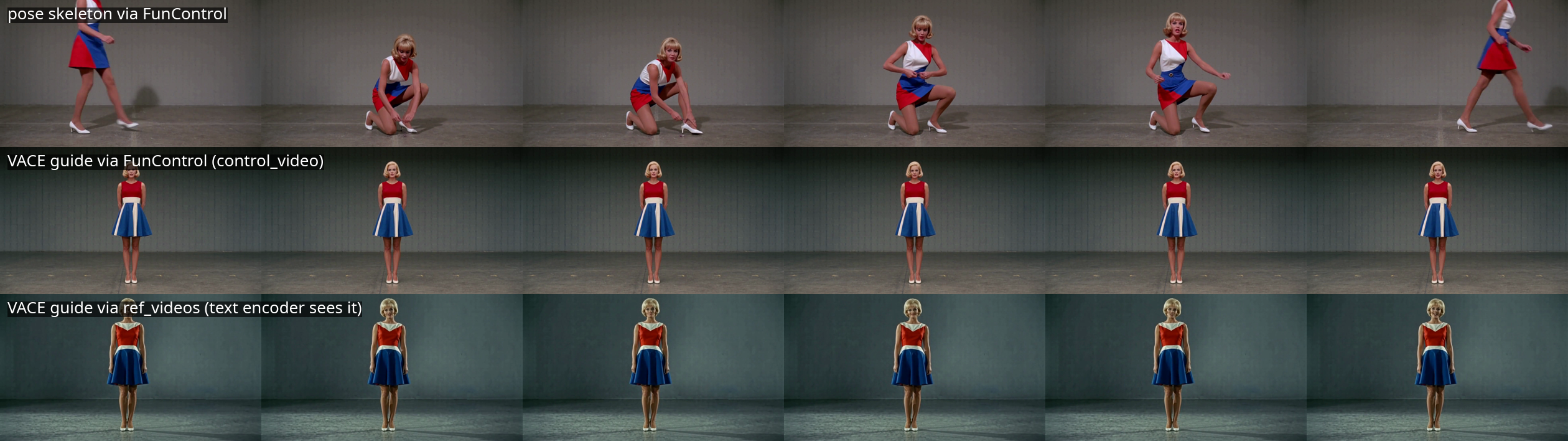
The skeleton row crouches to one knee and reaches toward the floor. Both guided rows hold one upright posture throughout. Neither shows a briefcase or a tripod, and neither reproduces the reach — through either input.
Mean absolute pixel difference, stride 8:
| seed floor (skeleton) | seed floor (guided) | between control types | ratio | |
|---|---|---|---|---|
| simple subject | 11.38 | 17.30 | 21.69–25.59 | 2.25x |
| complex subject | 10.82 | 17.09 | 21.84–29.00 | 2.68x |
ref_videos |
11.38 | 7.16 | 25.39–25.54 | 3.57x |
The guide is not inert. In every case it moves the output further than changing the seed does — two to three and a half times further. What it produces is a subject holding a posture rather than performing an action.
Under ref_videos the seed floor is 7.16, lower than the skeleton arms'
11.38 in the same build. A reference video makes the output more stable across
seeds, not less: it acts as a prior on what the shot looks like, not as an
instruction for what happens in it.
The subject is not the reason
A sparse prompt might plausibly leave H3 with too little to hold onto. The complex-subject row above uses a prompt specifying skin, hair, face, physique, wardrobe and a named held object, drawn from a seeded palette grammar rather than written to taste. It changes nothing: the guided arms hold the same upright posture, and their measured motion stays low.
What the prompt does carry
The complex subject's prompt names an object — a mysterious reel of magnetic tape clutched in one hand. Under pose control, it appears:
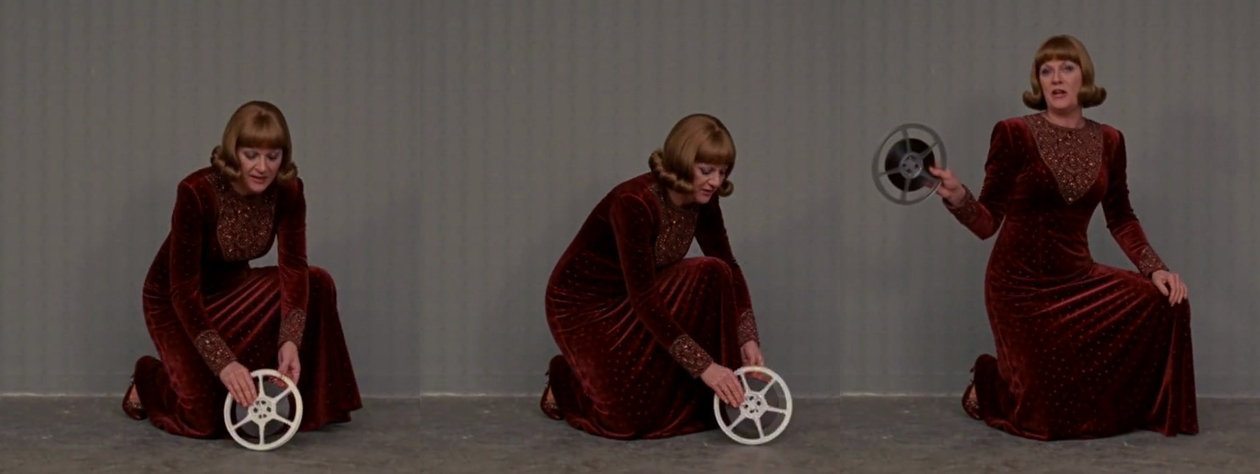
She is doing the skeleton's action and holding the prompt's object. The reel is carried while walking, set down during the crouch, and lifted again afterwards.
Props come from the prompt, and this is the direct demonstration: an object named in the text appears in frame while the body obeys a control video that knows nothing about it.
The subject does not have to be human
A pose skeleton describes human joints. Whether that is why it works is a separate question, and every subject above is a person.
Three body plans, drawn from a seeded palette grammar, under the same skeleton:
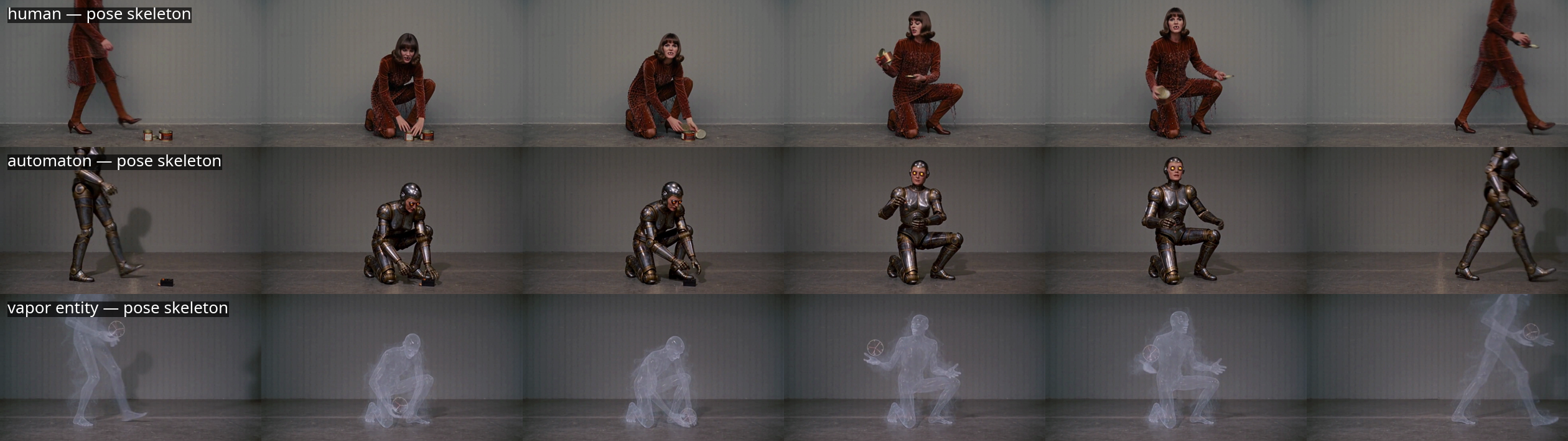
The automaton walks in, kneels, works at floor level and stands, in the same choreography as the woman. The vapor entity does the same while remaining translucent mist throughout. Neither has human joints in the sense the skeleton describes. Both follow it.
Each subject also stays what the prompt asked for. The machine is brass and steel from first frame to last; the mist never solidifies. The control supplies the choreography and takes nothing from the identity.
Temporal motion within each clip — mean absolute difference between frames one second apart — confirms the pattern holds per body plan:
| subject | pose skeleton | VACE guide | ratio |
|---|---|---|---|
| woman | 8.83 | 3.91 | 2.26x |
| automaton | 6.93 | 4.30 | 1.61x |
| vapor entity | 4.26 | 1.20 | 3.55x |
Absolute values are not comparable across subjects — mist displaces fewer pixels than a velvet dress whatever it does — but the within-subject ratio is.
These are clip averages, and a low average means the subject is not performing the guide's action — not that it is frozen. The shape behind the average is not stable across seeds: the automaton's guided arm rises from 1.32 to 2.96 across one clip and holds flat at 1.01 to 1.28 at the next seed. Only the gap between controls replicates.
A pose is not an action
The automaton shows what the guide does transmit, because the two controls split cleanly on it. Under the pose skeleton it walks on camera, kneels, works at something on the ground, and walks off — the guide's whole action. Under the guide itself it is kneeling in the first frame and still kneeling in the last. It never kneels down.
Both hold at two seeds. What crosses is the kneel as a standing condition, with none of the movement that produced it: the guide transfers a pose, and the action does not survive the trip.
Who was right
The dispute resolves cleanly, and not entirely in either direction.
He is right that a VACE guide is cheap to produce relative to an H3 render, and right that the guide is a real signal — it changes the output decisively. He is wrong that it makes H3 "do absolutely anything as intended". Through both of H3's video inputs, a guide full of visible props produced neither the props nor the action.
The published limitation survives, and the mechanism is now better described than it was: the control video contributes structure, the prompt contributes content. A pose skeleton is a good structural signal — good enough to move a machine and a cloud of vapor through a human choreography. A photoreal guide is a worse one, because its structure is buried in appearance the model does not use.
One tempting explanation is ruled out by the second pathway. If FunControl
simply reads structure and ignores appearance, then ref_videos — which shows
the frames to the text encoder — ought to be where appearance gets through. It
is not. Both pathways fail the same way, so the limit is not peculiar to how
control tokens are injected.
Cost
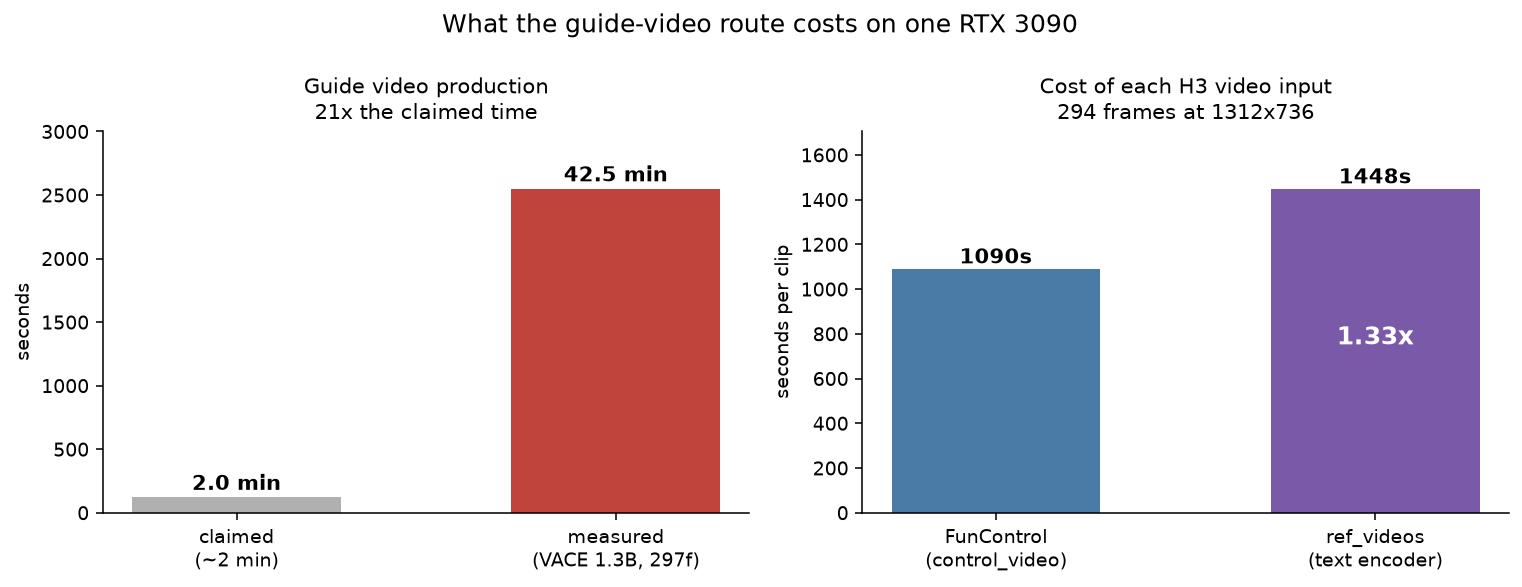
The guide takes 42.5 minutes, not two. 2547.9 s by ComfyUI's own execution
timestamps, excluding queue and model load, for 297 frames at 832x480, 20 steps,
VACE 1.3B fp16 on an RTX 3090. That is 21x the claimed figure. The gap is large
enough that it probably reflects a different configuration — a much lower step
count, a shorter clip, or the rcm 1.3b speed path also mentioned — rather than
a disagreement about the same work.
Per clip, ref_videos costs 1.33x what FunControl costs — 1447.7 s against
~1090 s. Consistent with the node's own tooltip: reference tokens ride through
every sampling step, where control tokens are injected at one layer inside a
window.
Reference length is capped by memory, not by taste. adapt_canvas() resizes
a reference up to a 768-short-edge canvas, so a 294-frame reference at
1312x736 adds ~87,700 tokens against the shot's own 82,000 and the sequence more
than doubles. That OOMs on a 24 GB card at 20.17 GiB allocated. A 90-frame
reference — 4 s, inside the node's stated 2-15 s range — adds ~18,100 and fits.
Nine builds, roughly 7h15m of GPU under lock, plus ~50 minutes idle between builds. Three builds failed: a missing module in a task script; a guide generated at the source clip's resolution rather than the shot's, rejected by the node on a token-count mismatch; and the reference-length OOM above. On a single card those failures are the schedule, not a footnote to it.
Calendar: the reply landed 2026-09-18T04:42Z and the answer was published the same day. A day is what the measurement costs once the rig exists — GPU lock, artifact egress, fixture validation, a pre-flight that refuses to deploy a graph naming an encoder H3 cannot load. That rig took weeks and is the reason the answer took a day.
What this does not settle
- Two of the recipe's components, not the recipe. The storyboard grid split into a control video, the "128rbg spacing", the ExVideo/RifleX long-context path and an LLM-written prompt are all untested. This refutes a VACE guide carries props into H3, not his whole workflow.
- Both inputs at once. "Combining" is a fair reading of the comment and remains unrun. It is the obvious next experiment.
- The guide depicts a different figure from the prompt's subject. If the intended workflow is that the guide already resembles the target shot, that is a different procedure and would deserve its own test.
- VACE 1.3B, upscaled from 832x480. The 14B model and a natively full-resolution guide are both untested.
- Three body plans, only one of them replicated. The automaton ran at two seeds; the woman and the vapor entity at one. Three points, not a survey of what H3 will accept as a body.
- The pose-without-action reading rests on one subject at two seeds. The automaton is the only arm where a guided subject adopts a posture at all, so the distinction it draws is not yet known to generalise.
Files
- Pixel scores, simple subject
- Pixel scores, complex subject
- Pixel scores, ref_videos
- The scoring script
- Motion scores by body plan
- Per-interval motion profiles
- The guide-render script
Workflows are API-format and name local checkpoints; they are a starting point, not a drag-and-drop.