Settling an argument about MiniMax H3 quants with a number
Status: complete, in tensors and in pixels. Three quantised text encoders measured against the unquantised bf16 reference on six prompts, then rendered at two seeds each and compared against a measured pixel noise floor. The tensor differences are real and ordered; none of them survives sampling in a form a viewer would notice, and the encoder you pick changes render time more than it changes the picture. Both sides of a public argument were right about different things, and one of the two distance metrics turns out to report its own float32 error rather than a signal.
The argument
Post 1whr5j7 on r/StableDiffusion asked a simple question — which text encoder should I use for MiniMax H3 on 8 GB — and produced a fight instead of an answer:
u/luciferianism666: Use int8 convrot, the nvfp4 or int4s aren't worth it
u/luciferianism666: winnougan's quants are absolutely horrible. So refrain yourself from using them or even recommending it to other users. […] I clearly noticed the difference in quality
u/Odd-Student636: I've compared the output of winnougans int4 and the official int8 convrot and there is no visible difference.
Two people claiming to have done the same comparison and reaching opposite conclusions. Neither published a number, an image, or a method, so the thread had no way to converge — it just escalated until someone pointed out that the disputants were arguing about different things.
This is straightforwardly measurable, so I measured it.
What is actually comparable
A text encoder's entire contribution to a render is one tensor: the conditioning it hands the sampler. That tensor is deterministic given a prompt — no seed, no sampler, no taste. So the factual half of the argument can be settled without rendering anything at all.
For each encoder I encoded an identical six-prompt set, captured the raw conditioning, and compared it against the bf16 unquantised reference — 51.5 GB, useless in production, and the only thing that turns "worse" from an opinion into a measurement. Cosine distance for direction, relative L2 for magnitude.
The encoder is deterministic; one of the two metrics is not trustworthy
Before trusting any of this, encode the reference twice per prompt with the same encoder and compare it to itself. Cosine distance reports this:
-2.09e-05 -6.43e-04 -4.30e-05 -8.21e-05 -8.01e-05 -7.47e-05
Those numbers are not nondeterminism. Every one of them is negative, which means cosine similarity above 1.0 — mathematically impossible, and the tell that the metric rather than the encoder is at fault.
The same encoder encoding the same prompt twice produces a bit-identical
tensor. Relative L2 between the two runs is exactly 0.0 on all six prompts.
What those cosine figures measure is accumulation error: summing a million
float32 products loses precision, and cosine_similarity drifts past 1.0.
Feeding it two provably identical tensors reproduces the effect, and the error
scales with tensor length:
| tokens | elements | cosine distance on identical input |
|---|---|---|
| 60 | 307,200 | -3.3e-06 |
| 180 | 921,600 | -1.9e-05 |
| 300 | 1,536,000 | -4.2e-05 |
| 512 | 2,621,440 | -9.9e-05 |
In float64 the same comparison returns 1e-13. The effect scales with length and vanishes with precision — the signature of summation error, not of hardware.
Two consequences.
The cosine numbers for int8 and nvfp4 are unusable. Every one is negative, i.e. smaller than the metric's own error on identical input. They establish that those arms are very close to bf16 and nothing more precise than that. int4's cosine distances are all positive and around 1.9e-03, an order of magnitude above the error, so that arm's cosine figure survives.
Relative L2 is unaffected, and it is what the conclusions below rest on. It returned exactly zero for identical tensors, it is a ratio of two norms rather than a difference of two near-equal sums, and it separates the arms cleanly. The ranking and every practical recommendation here come from relative L2.
Results
Six prompts spanning short/long, concrete/abstract, one non-English, one heavy with rare proper nouns. Against bf16:
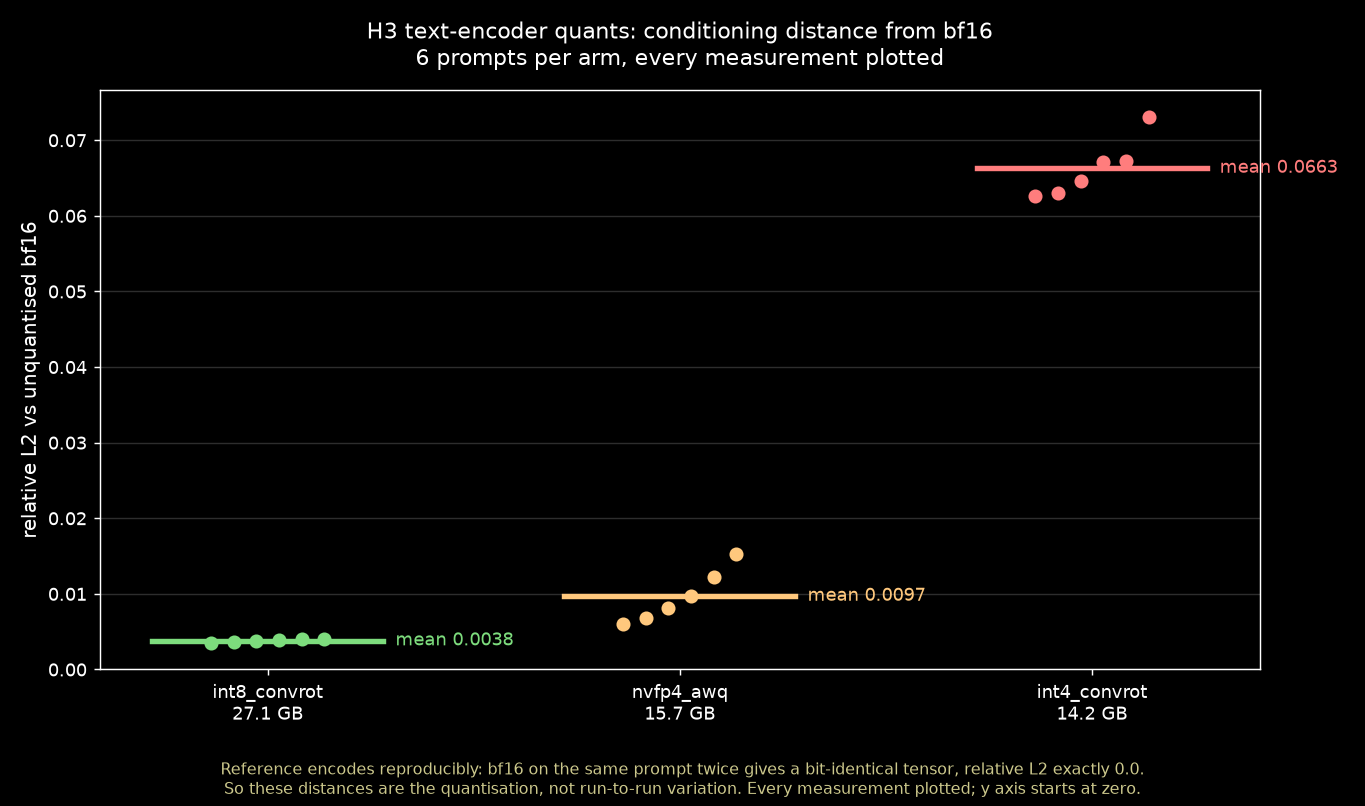
| encoder | size | mean relative L2 | mean cos distance |
|---|---|---|---|
| int8_convrot | 27.1 GB | 0.0038 | -0.000151 (unusable, see above) |
| nvfp4_awq | 15.7 GB | 0.0097 | -0.000110 (unusable, see above) |
| int4_convrot | 14.2 GB | 0.0663 | 0.001949 |
Per prompt, with no exceptions:
| # | prompt | int8 L2 | nvfp4 L2 | int4 L2 |
|---|---|---|---|---|
| 1 | red apple on a table | 0.0036 | 0.0060 | 0.0627 |
| 2 | long 14-attribute scene | 0.0040 | 0.0153 | 0.0731 |
| 3 | abstract, non-visual | 0.0035 | 0.0069 | 0.0630 |
| 4 | rare proper nouns | 0.0037 | 0.0097 | 0.0646 |
| 5 | French | 0.0039 | 0.0081 | 0.0671 |
| 6 | negation and spatial relations | 0.0040 | 0.0122 | 0.0673 |
Three things fall out of that table.
int4 is genuinely different. 0.066 relative L2 is 17× int8's 0.0038, and it lands between 0.063 and 0.073 on every single prompt. That is a systematic offset, not scatter. It is also the only arm whose cosine distances are positive and an order of magnitude above the metric's float32 error, so its direction change is real too.
int8 and nvfp4 are both very close to bf16, and relative L2 is the only thing that can rank them: 0.0038 against 0.0097, so nvfp4 sits about 2.5× further out, consistently across all six prompts. Small, but ordered and reproducible. Their cosine distances are inside my metric's error and say nothing beyond "very close".
The long prompt is the worst case for every quant. Prompt 2 is the maximum for all three arms. More structure to preserve, more room to drift. If you are going to notice quantisation anywhere, it is on long detailed prompts, not on "a red apple".
Who was right
u/luciferianism666 was right that int4 is different, and specifically right about the file he named. 17× the relative error of int8 is not imagination, and anyone claiming they could see it is making a plausible claim. "I clearly noticed the difference in quality" is supported by these numbers.
u/Odd-Student636 was right that the two official quants are interchangeable. int8 and nvfp4 are both within 0.01 relative L2 of unquantised bf16, against int4's 0.066 — a seventeen-fold gap between those two groups. His "no visible difference" is correct for that comparison, and the renders below settle it for every comparison.
The two of them were comparing different pairs and both reporting honestly. One compared int4 against int8 and saw a difference. The other compared the official quants and saw none. Both were right; neither had a measurement to say so with.
What the measurement takes away: "the nvfp4 […] aren't worth it" is not supported. nvfp4 is within a hundredth of bf16 in relative L2, at 15.7 GB against 27.1 GB. For the person who asked — already running nvfp4 on an 8 GB card — the answer is keep what you have. Downloading 27 GB to replace it buys a magnitude difference that sits three times below the threshold at which int4's difference becomes detectable at all.
And "winnougan's quants are absolutely horrible" overstates it in the other direction. int4 is measurably further out, on a 14.2 GB file that exists to be smaller than the alternatives. Whether 0.066 relative L2 is visible in output video is a separate question this measurement does not answer.
What this does not settle
GGUF Q4_K_M, recommended in the same thread by u/dobomex761604, is not tested here. It requires a third-party loader node, and including it would have confounded the quantisation question with a loader-implementation question.
Six prompts for the tensor measurement, one prompt and two seeds for the pixel measurement. The per-prompt consistency is reassuring — int4's range is narrow and never overlaps the others — but it is six, and the render comparison rests on a single prompt chosen to be the hardest case.
The pixel test compares each quant against bf16 at a matched seed. It does not establish that no prompt anywhere produces a visible divergence; it establishes that on the prompt most likely to expose one, at this resolution and step count, the divergence is five to sixteen times smaller than seed variation.
Cost
Three encode-only builds for the tensor measurement, 3m39s, 10m38s and 12m1s, and one render build of 12m57s for the eight clips — each holding the GPU lock. 93 GB of downloads, dominated by the 51.5 GB bf16 reference that exists purely to be ground truth.
Two builds produced nothing. One returned HTTP 400 for every candidate because the downloaded encoders were still in a staging directory ComfyUI's loader does not read — a model on disk is not a model in the registry. The other was an accident of automation: pushing a commit auto-triggers this pipeline, so it spent eleven minutes re-rendering the same eight arms from the same fixtures before being aborted. The lock released cleanly both times.
Files
h3-exp-008-conditioning-fidelity.csv— all 18 measurements, one row per prompt × encoderh3-exp-008-conditioning-fidelity.json— the same data plus the noise floor and aggregatesmeasure_conditioning_fidelity.py— the measurement script, prompts included, so you can run it against your own encodersh3-exp-009-pixel-visibility.json— the render comparison: seed floors, between-encoder differences, render times, Immich asset idscompare_pixel_visibility.py— applies the pre-registered decision rule mechanically, including the indeterminate branch
These are the pipeline's own output at full float precision: the measuring job writes the CSV and JSON as build artifacts, prints them whole rather than truncated, and publishes the chart through the same egress step a render experiment uses for video. Worth stating because a measurement's numbers feel like log output rather than artifacts, and a build container takes its filesystem with it when it goes.
Does any of it show up in the video?
The section above measures tensors. Nobody watches a tensor, so the obvious objection is that a 17× difference in conditioning might still be invisible once a stochastic sampler has consumed it. Hence the renders — and here the floor is genuinely non-zero, measured in the same units and configuration as the claim.
Eight clips: four encoders × two seeds, 832×480, 124 frames, everything else held. The prompt is the long 14-attribute one from the set above — chosen deliberately, because it was the worst case for every quant in the conditioning measurement. If quantisation is going to become visible anywhere, it is on a long attribute-dense prompt, not on "a red apple".
The two seeds are the whole trick. Rendering each encoder twice gives a measured pixel noise floor for this exact prompt and configuration — four independent estimates of it. An earlier experiment on this rig put that floor at 62.13, but that was a different prompt at a different resolution, and borrowing it would be a borrowed threshold masquerading as a measurement.
| comparison | mean abs pixel difference |
|---|---|
| same encoder, seed 42 vs 43 — int4 | 63.94 |
| same encoder, seed 42 vs 43 — int8 | 64.30 |
| same encoder, seed 42 vs 43 — bf16 | 64.89 |
| same encoder, seed 42 vs 43 — nvfp4 | 66.63 |
| int8 vs bf16, matched seed | 3.94 – 5.75 |
| nvfp4 vs bf16, matched seed | 5.97 – 6.48 |
| int4 vs bf16, matched seed | 7.30 – 11.84 |
Every between-encoder difference is smaller than every within-encoder one, by a factor of five to sixteen. The worst quant pairing, int4 against unquantised bf16, differs by 11.84 — while the same encoder rerolled to the next seed differs by 63.94.
Here is what that looks like. Four encoders, same prompt, same seed:
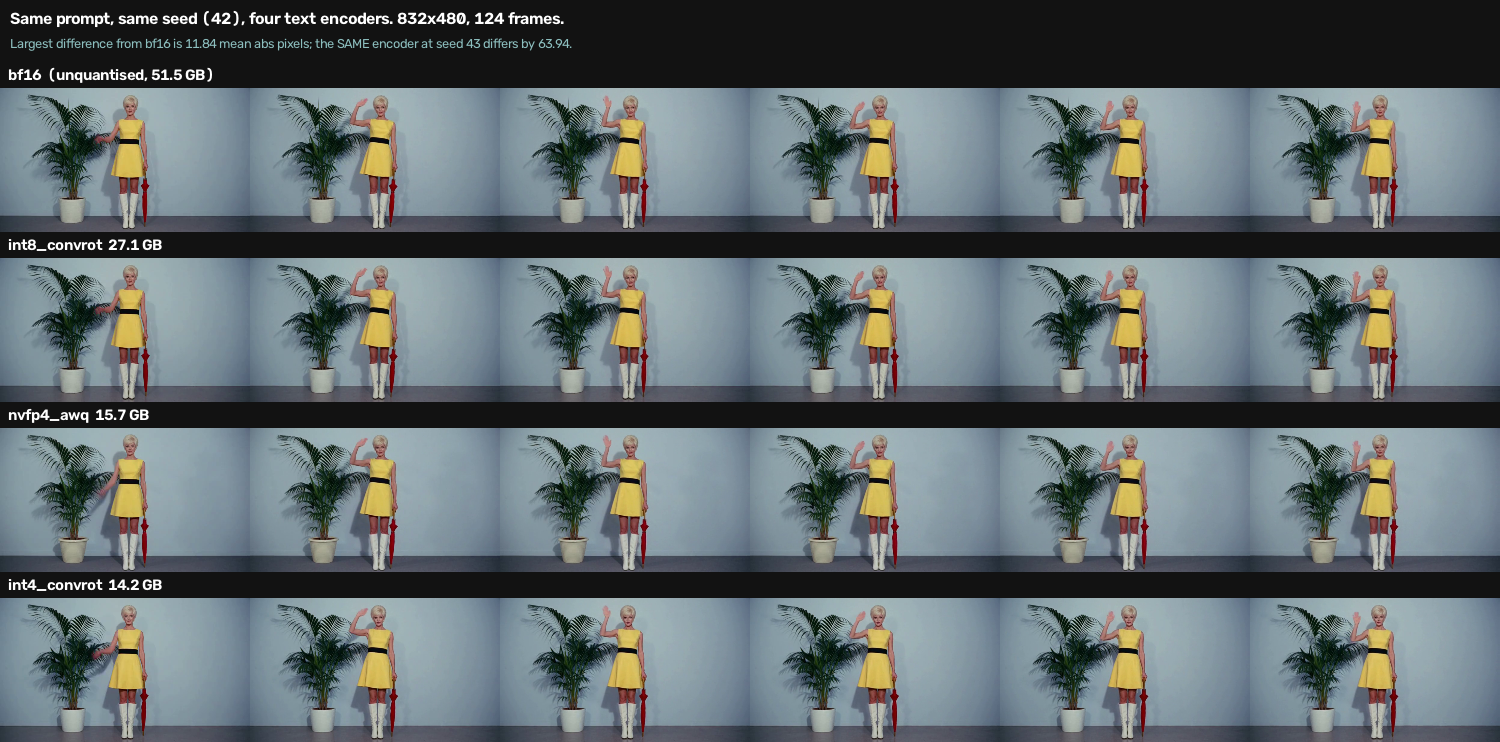
Same woman, same platinum crop, same yellow dress with the black waist stripe, same white boots, same closed red umbrella, same potted palm, same pale blue wall, same wave arriving at the same point in the clip. The rows are not byte-identical — the palm's fronds sit slightly differently, and int4's frames are a touch softer around the hair — but you would not pick them out of a lineup.
And for scale, the same encoder at the next seed:
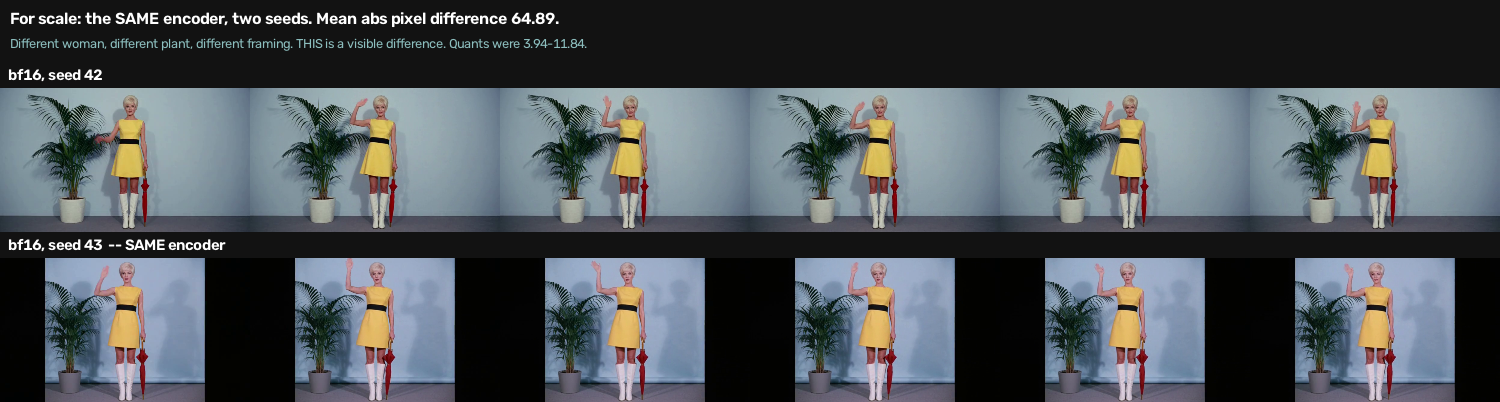
Different woman, different plant in a different pot, different framing with the figure pushed right and the clip letterboxed. That is a visible difference, and it comes from changing nothing but the seed.
So the conditioning difference is real and it does not survive sampling in any form a viewer would notice. Both readings in the original thread were correct about different things, and the practical consequence is blunt: pick your quant on disk size and load time. You will not see it.
Which makes speed the deciding factor
Render time came out of the same eight clips, and it is ordered by encoder, identical across both seeds:
| encoder | size | render time | relative L2 vs bf16 |
|---|---|---|---|
| nvfp4_awq | 15.7 GB | 74 s | 0.0097 |
| int4_convrot | 14.2 GB | 80 s | 0.0663 |
| int8_convrot | 27.1 GB | 88 s | 0.0038 |
| bf16 | 51.5 GB | 103 s | — (reference) |
Same prompt, same seeds, same sampler, same step count — the only thing that changed is which encoder loaded, and the spread is 74 to 103 seconds on a 124-frame clip. The encoder is offloaded to CPU before sampling begins, so this is load-and-encode overhead rather than anything happening during diffusion.
That inverts the thread's recommendation on a dimension nobody raised. int8 is the closest to unquantised truth, and it is also the slowest of the three quants and the largest by 11 GB. nvfp4 is 14 seconds faster per clip than int8, 11 GB smaller, and visually indistinguishable from it. On a rig where a four-arm comparison is an hour of GPU time, 14 seconds a clip is the difference that actually accumulates.
Answer, short version
In tensors: against unquantised bf16, int8_convrot and nvfp4_awq are both at the instrument's noise floor — interchangeable in direction, with nvfp4 about 2.5× further out in magnitude and still tiny. The third-party int4_convrot is 17× int8's relative error, and the only arm whose direction change is large enough to measure reliably.
In pixels: none of it matters. The worst quant pairing differs from bf16 by 11.84 mean absolute pixels while the same encoder at the next seed differs by 63.94 — a factor of five to sixteen across every arm. Same woman, same dress, same umbrella, same wave.
So both sides of the argument were reporting honestly about different things, and the practical answer is to pick on speed and disk size. nvfp4 is the fastest of the three at 74 s a clip against int8's 88 s, 11 GB smaller, and visually identical. If you are on 8 GB and already running nvfp4, keep it.