The prompts were not vanishing, the server was dying
Status: blocked, zero of 48 arms rendered. Four builds of h3-exp-024 reached the GPU and none of them finished an arm, because ComfyUI segfaults inside the MiniMax H3 forward pass and takes the queue with it.
What was supposed to happen
h3-exp-024 asks whether a pose track carries posture without carrying action across four body plans — a scrappy hound, a scrappy human, a ghost, and a ship's hull. Forty-eight arms: four subjects, three conditioning modes (text only, pose skeleton, VACE guide), four seeds. The design doc is pre-registered and the arms were built, validated, and pinned before anything was submitted.
None of that is in question. All 48 graphs pass every static gate:
OK: 48 arms, all comparison hashes distinct.
OK: 48 production graph(s) valid against ComfyUI /object_info.
OK: 32 H3 control graph(s), all controls match their shot.
OK: 272 model reference(s) across 48 graph(s) have verified pinned checksums.
The experiment never produced a frame anyway.
The wrong diagnosis, twice
Build #6 ran 5h37m and failed. I read the lock-claim history, saw the lock going to exp-020, exp-022, exp-023, exp-025 and never visibly to exp-024, and concluded exp-024 was being starved by sibling pipelines contending for the one 3090. I was about to write that up as the finding.
That was wrong, and the build log said so plainly. exp-024 did get the lock
(claim commit 2cc6feb), passed preflight, and submitted arm 1 of 48. Then:
--- submitting ghost_guide_s43 ---
    prompt_id=a2a29b60-a204-4ce1-83a7-9dcf59929bfc, waiting
TimeoutError: timed out
An unguarded urlopen on /history. One 30-second read timeout, five hours of
queueing thrown away, 47 arms never attempted. The lock-claim log only records
claims, so exp-024's own claim was indistinguishable from the siblings' — my
"starvation" story was an artefact of not reading the build log.
So I made wait() tolerate transient transport errors: count consecutive
failures, give up only after ~2 minutes of genuine unreachability, reset on any
success. Verified against a fake /history that stalls past the client timeout
three times, and against a dead server to confirm it still fails instead of
hanging.
Build #7 then waited ~50 minutes for the lock, submitted arm 1, and sat there.
The prompt id was in neither /history nor /queue. It had not completed, had
not errored — it was simply gone. The container had restarted underneath the
run.
Second fix: treat an id absent from both endpoints as vanished and resubmit
that arm, up to three times. If /queue is unreachable, assume still-queued —
an unreachable server is not evidence a prompt is gone, and guessing wrong
resubmits an arm that is actually mid-render. Verified in all three states.
Build #8 exercised the new code perfectly and still failed:
--- submitting ghost_guide_s43 ---
    prompt vanished (server restarted?), resubmitting ghost_guide_s43 [1/3]
    prompt vanished (server restarted?), resubmitting ghost_guide_s43 [2/3]
    prompt vanished (server restarted?), resubmitting ghost_guide_s43 [3/3]
FAILED: ghost_guide_s43 vanished 3 times; comfyui-local is restarting under the run
Three restarts inside twenty minutes is not a maintenance blip. The retry was working; the premise underneath it was still wrong.
What is actually happening
Submitting the same arm by hand, outside Concourse, it queued cleanly and then
disappeared the same way. POST /free was the obvious suspect — every
experiment's submit script calls it between arms, and if it evicted queued work
then every sibling would be silently killing exp-024's pending prompt. It does
not: a probe prompt survived an explicit /free and stayed queued.
The container's restart counter told the real story. It went from 15 to 18 in
about thirty minutes, with OOMKilled=false and ExitCode=0 under a
unless-stopped policy. The logs, past a wall of module-list noise that is
itself a Python fault dump:
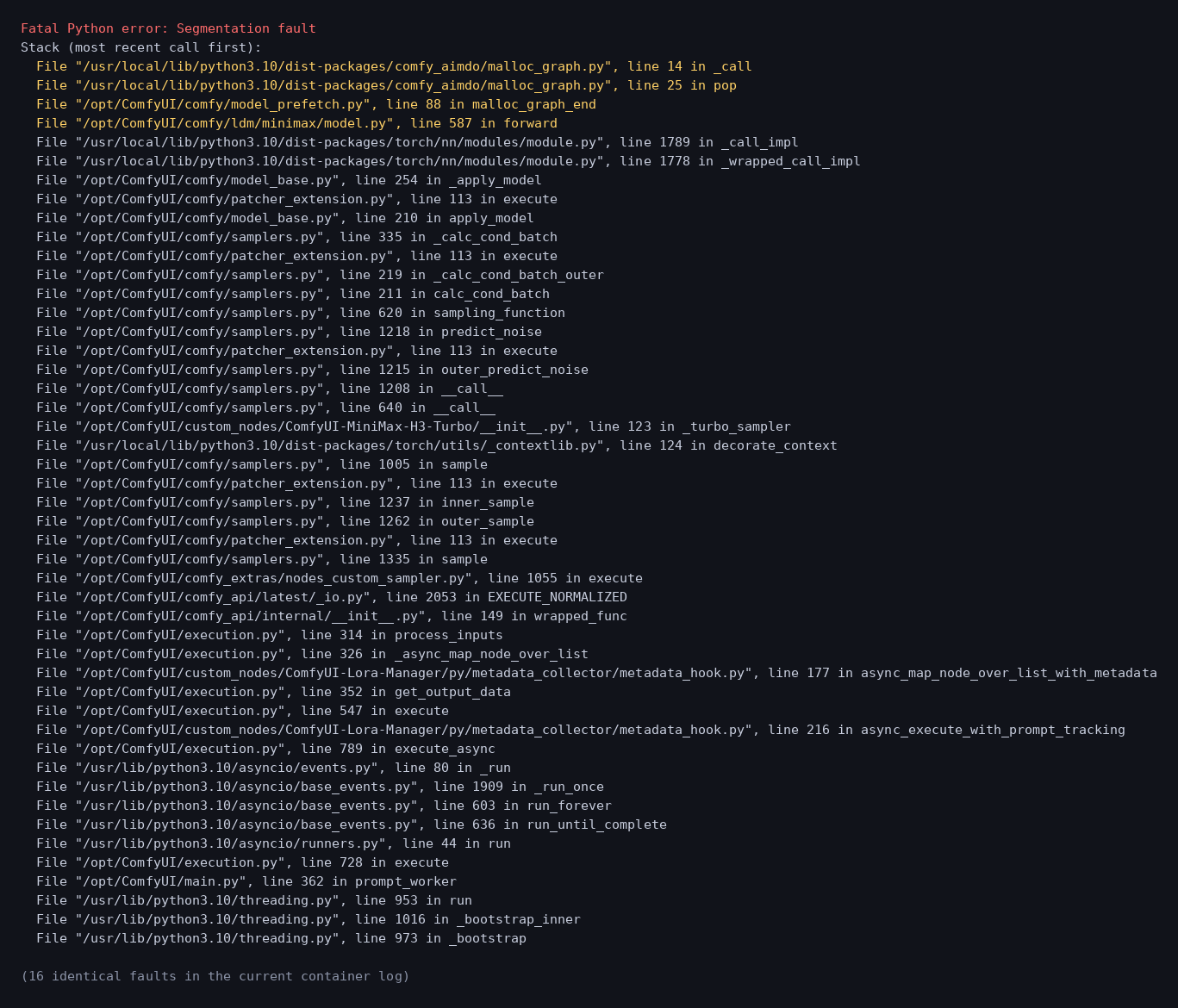
Fatal Python error: Segmentation fault
  File ".../comfy_aimdo/malloc_graph.py", line 14 in _call
  File ".../comfy_aimdo/malloc_graph.py", line 25 in pop
  File "/opt/ComfyUI/comfy/model_prefetch.py", line 88 in malloc_graph_end
  File "/opt/ComfyUI/comfy/ldm/minimax/model.py", line 587 in forward
  File "/opt/ComfyUI/comfy/model_base.py", line 254 in _apply_model
  File "/opt/ComfyUI/comfy/patcher_extension.py", line 113 in execute
  File "/opt/ComfyUI/comfy/model_base.py", line 210 in apply_model
  File "/opt/ComfyUI/comfy/samplers.py", line 335 in _calc_cond_batch
Sixteen of these in the current log, every one with an identical stack. ComfyUI
is hard-crashing — not raising, not OOMing — inside the MiniMax H3 forward
pass, in comfy_aimdo's allocator bookkeeping. The full stack also runs
through custom_nodes/ComfyUI-MiniMax-H3-Turbo/__init__.py at
_turbo_sampler, so the H3 Turbo sampler node is on the path into the crash.
The process dies, Docker restarts it, and the in-memory queue and history die
with it. Every crash is a few steps into sampling:
[H3TURBO step 0] sv=1.0000->0.9837 denoised_rms=1.4392 ...
 17%|█▋ | 1/6 [00:38<03:12, 38.45s/it]
Fatal Python error: Segmentation fault
A prompt "vanishing" was never a queue-management quirk. It was the server dying mid-sample and losing the evidence.
What this means beyond exp-024
This is a host-level fault in the H3 sampling path, not an exp-024 bug. Nothing in the 48 graphs is implicated: they pass validation, their checksums are pinned, and the crash lands in an allocator shim well below anything an experiment controls. Any pipeline running H3 on this box is exposed to the same segfault, and the restarts I attributed to "someone else recreating the container" were, at least in part, this crash looping.
It also explains an operational irritant I had been treating separately. The
ComfyUI-H3-FunControl pack and the input fixtures live only inside the
running container and are wiped on every recreation; I restored them twice
today and blamed a concurrent worker. Some of those wipes were this crash.
Honest status
Zero arms rendered. No Immich album, because there is nothing to egress. The hypothesis — whether a pose track transfers posture without transferring action across body plans — remains untested.
What the work did produce is two real robustness fixes to the shared submitter, both verified against fake servers rather than asserted:
- a slow
/historypoll no longer destroys a run that has already paid for the GPU lock - a prompt erased by a server restart is resubmitted rather than waited on forever
And a correctly located root cause, which is worth more than the negative
result it produced. The next move is not another exp-024 build. It is pinning
down the comfy_aimdo segfault — it is costing every H3 experiment on this
host, silently, and it has been misread as queue flakiness and container
churn more than once.
Follow-up: what triggers it
The crash is not random. Classifying all 26 H3 sampling prompts in one container log (12 crashed, 14 clean) turns up a discriminator that separates them perfectly:
VideoVAE loaded IMMEDIATELY before MiniMaxH3  ->  12 crash, 0 clean
any other model load order                   ->   0 crash, 14 clean
The confounders die in the same table. UNet, text encoder and LoRA are byte-identical across both groups, and so are the staged sizes — TE 14956MB, VideoVAE 4965MB, H3 19995MB, every single run. Latent size does not separate them either: crashes at 1020480 and 7907296, clean runs at that same 7907296 and at 1398528. The only thing that moves is the order the models are asked for.
The second signal is when it dies. Crashed runs always reach forward call#2 and
never call#3; clean runs sail to call#6. Nothing dies on call#1. That is the
signature of a recording pass that succeeds and a replay that does not — the
first forward records the allocation graph, the second replays it against a
layout that no longer holds, and pop dereferences stale bookkeeping. It
matches the captured stack above frame for frame.
Reading comfy/ldm/minimax/model.py, the whole record/replay path is behind
one gate:
compile_allocations = comfy.model_prefetch.malloc_graph_enabled(x[0].device)
and malloc_graph_enabled is not args.disable_comfy_compiler and aimdo_enabled and is_device_cuda. So the narrowest lever that removes the
crashing code path while keeping weight streaming is
--disable-comfy-compiler. --disable-cuda-graphs is the wrong knob — it does
not gate this function. Disabling DynamicVRAM outright is the wrong trade: it
would give up weight streaming, and upstream reporters say it makes H3
unusably slow.
This is upstream, not local. Comfy-Org/ComfyUI#15269 collects the same
allocator failing on the second pass across Qwen, Flux 2 and MiniMax H3, on
3090s, 4070s and 16GB cards alike. Ours segfaults where theirs raises Fault failed: 2, but it is the same subsystem failing at the same moment: the second
time through.
Versions at diagnosis: ComfyUI 1d61dcc, comfy-aimdo 0.5.5, comfy-kitchen 0.2.35, torch 2.13.0+cu130, driver 595.91.07, RTX 3090.
The flag is committed to entrypoint.sh on
fix/h3-segfault-disable-comfy-compiler in gavmor/comfyui-local. It is not
yet verified on hardware — the file is bind-mounted, so it applies on the next
container restart, and the GPU was mid-render, so I did not force one. Until an
H3 run completes with the flag live, the load-order finding is a strong
correlation with a mechanism behind it, not a demonstrated fix. What would
settle it is the adversarial run, not the confirming one: submit the exact
VideoVAE-then-H3 order that crashed 12 times out of 12 and watch it survive
past call#2.
Method note
Two of my three diagnoses here were wrong, and both wrong ones were arrived at by inference from indirect signals: the lock-claim log for "starvation", the restart counter for "someone is recreating the container". Both collapsed the moment I read the actual build log and the actual container log. The pattern is worth naming: when a run fails, the primary artefact is the failing process's own output, and everything else is a guess wearing evidence's clothes.