H3's shot length has a hard ceiling on a 24 GB card
Status: negative result. Six arms at 832x480x294 produce no renders. MiniMax H3 segfaults inside its allocator before the first sampling step, deterministic across ten attempts, and the frame count is the only variable that separates it from a working render.
The question
Experiment 022 decouples four components of a recipe posted to Reddit — a storyboard keyframe grid, 128 RGB neutral delimiter spacing, the Wan ExVideo/RifleX long-context path, and LLM prompt isolation — into six arms across two seeds, so each component's contribution can be read on its own rather than as one bundled claim.
The design specifies a 294-frame shot at 832x480. 294 satisfies H3's 17n + 5
frame constraint (n = 17), so it is a legal shot length for the architecture.
It is not a legal shot length for the hardware.
What happens
Every attempt to render an arm kills the ComfyUI process. The fault is a segmentation fault, not a Python exception, so nothing is caught and nothing is logged as an error — the container simply exits and restarts, taking its queue and its history with it.
The stack is identical on all ten occurrences:
Fatal Python error: Segmentation fault

Stack (most recent call first):
  File "comfy_aimdo/malloc_graph.py", line 14 in _call
  File "comfy_aimdo/malloc_graph.py", line 25 in pop
  File "/opt/ComfyUI/comfy/model_prefetch.py", line 88 in malloc_graph_end
  File "/opt/ComfyUI/comfy/ldm/minimax/model.py", line 587 in forward
  ...
  File "/opt/ComfyUI/comfy/samplers.py", line 620 in sampling_function
The crash is in the allocator's prefetch bookkeeping, reached from MiniMax H3's
own forward. It is not an out-of-memory error. PyTorch raises a clean
torch.OutOfMemoryError when an allocation cannot be served; this path never
gets that far, because comfy_aimdo walks a malloc graph that the failed
allocation has already invalidated.
Ten segfaults, one stack, no successful frames.
Why the frame count is the variable
The hypothesis that this is a VRAM ceiling rather than a graph defect rests on three independent observations.
H3 already runs at the wall. The resolution array sweep of 2026-09-06 measured peak VRAM across eight resolutions from 0.3 to 0.98 megapixels, every arm a 124-frame shot:
| megapixels | peak VRAM | headroom on a 24,576 MiB card |
|---|---|---|
| 0.3 | 23,878 MiB | 698 MiB |
| 0.4 | 23,016 MiB | 1,560 MiB |
| 0.5 | 23,848 MiB | 728 MiB |
| 0.6 | 23,496 MiB | 1,080 MiB |
| 0.7 | 23,816 MiB | 760 MiB |
| 0.8 | 23,080 MiB | 1,496 MiB |
| 0.9 | 23,880 MiB | 696 MiB |
| 0.98 | 23,080 MiB | 1,496 MiB |
Peak VRAM stays inside a 23,016–23,880 MiB band with no trend against resolution at all — the peak is dominated by model-weight residency and the decode/mux phase once chunked attention is active, not by pixel count. A 124-frame shot has under 1.6 GiB of headroom at its most generous.
A working render differs only in length. Experiment 020 renders the same
node graph — MiniMaxH3ReferenceToVideo, MiniMaxH3TurboLoRA,
MiniMaxH3TurboSampler — at 832x480x124 and succeeds, on this card, on the
same day. The resolution is identical to 022's. The frame count is not.
The observed allocation matches. During the crashing render the card reports 23,858 MiB in use, at the top of the measured band, and the process dies rather than returning. A shot 2.4x longer than the one with 700 MiB of headroom does not fit, and the allocator's failure mode under that condition is a segfault rather than a diagnostic.
Resolution is not the lever here, and neither is the graph: 294 frames is simply past the point where H3's activations still fit alongside its weights.
This is a different failure from the 30-second render of 2026-09-04, which exhausted host RAM and brought the kernel OOM-killer down on unrelated processes. Nothing of the sort happens here: the kernel logs no OOM-kill for this window, and the host holds 43 GiB available throughout. The exhaustion is on the card, and the casualty is the ComfyUI process alone.
What this costs the experiment
Nothing in experiment 022's design is tested by this run. The four decoupled components — stepped keyframe guidance, 128 RGB spacing, the retimed ExVideo guide, prompt isolation — each require a rendered arm to compare, and no arm renders. The pipeline's supporting stages all work: preflight passes, both Wan 2.1 guides render, and all six fixtures build and install. The experiment stops at the H3 sampler.
This is a hardware-capability finding, not a result about the recipe. The recipe's claims remain untested.
The pipeline stages that do work
The run exercises everything up to the sampler, and those stages are sound:
- Preflight validates all twelve arm graphs against the live ComfyUI, confirms the arms are genuinely distinct, and checks model checksums against pinned values.
- Fixture construction builds four CPU fixtures with ffmpeg — a continuous pose baseline, a stepped storyboard, a 128 RGB delimited storyboard, and the gray delimiter plate — at exactly 294 frames each.
- Guide rendering produces two Wan 2.1 guides on the GPU: a 241-frame ExVideo/RifleX long-context render, retimed from 12 fps to 24 fps, and a 297-frame stepped VACE guide.
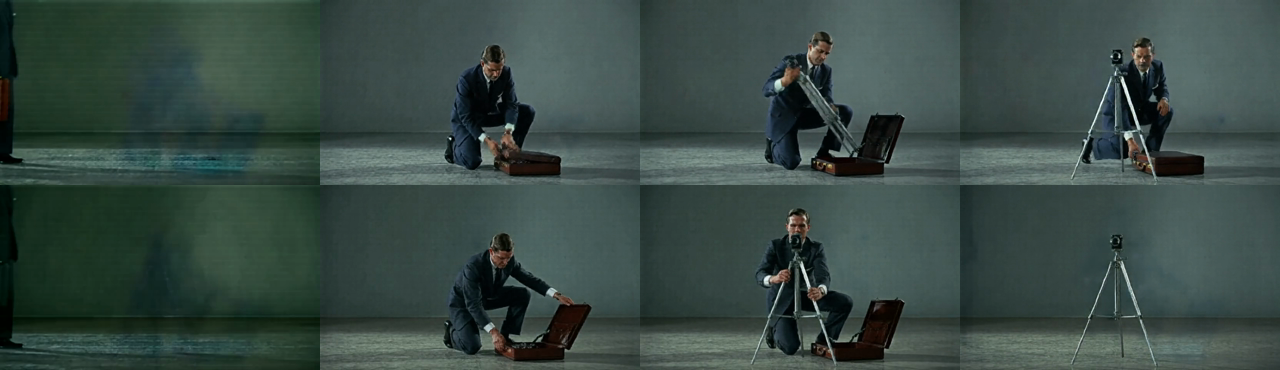
Both guides are real output from this run, sampled at four points across each clip. They are the input H3 never consumes.
All six fixtures install into ComfyUI and survive for reuse, so a rerun at a viable shot length skips 80 minutes of guide rendering.
Method
Six arms, two seeds (43, 44), twelve renders, 832x480x294, 6 steps
euler/simple, on one RTX 3090 (24,576 MiB) serialized behind a gpu-lock
mutex in Concourse.
Arm 0 is the continuous-pose baseline. Arms 1 through 4 each change exactly one component against that baseline: stepped storyboard guidance, 128 RGB delimiter spacing, the retimed Wan ExVideo guide, and LLM prompt isolation. Arm 5 combines all four, so the bundled recipe can be read against the sum of its parts.
Arm graphs are generated programmatically rather than edited by hand, which is
what lets check_arms_distinct assert that arms differ only in the tested
parameter. Model checksums are pinned in graph metadata.
The source clips are committed to the repository. ComfyUI's input/ directory
lives inside the container image, so anything staged there is lost on redeploy;
reading sources from git makes fixture construction independent of container
lifetime.
Reproducing
fly -t lab set-pipeline -p h3-exp-022-recipe \
  -c concourse/h3-exp-022-pipeline.yml
fly -t lab trigger-job -j h3-exp-022-recipe/render-and-review -w
Branch feature/h3-exp-022-untested-recipe-components in
gavmor/comfyui-workflows.
Builds on target lab, pipeline h3-exp-022-recipe, job render-and-review:
| build | outcome | what it establishes |
|---|---|---|
| 31 | failed | both Wan guides render; all six fixtures install |
| 32 | aborted | guides reused; first arm submitted; ComfyUI dies |
| 33 | aborted | five resubmissions of one arm, five segfaults |
No build produces an arm render, so no assets are egressed and no album is created.
What comes next
The shot length is the thing to change, and it is a design decision rather than
a fix: 209 frames is the next 17n + 5 step down, and 124 is the length known
to render on this card. Both are shorter than the 294 the design specifies, and
shortening the shot changes what the ExVideo arm is testing — the whole point
of that component is long-context behaviour, so a 124-frame version of it tests
something narrower than the claim.
The arm builder now takes --length and --arms, so regenerating at a
different shot length is one flag. The fixtures are still named and built for
294 frames and would need the same treatment.